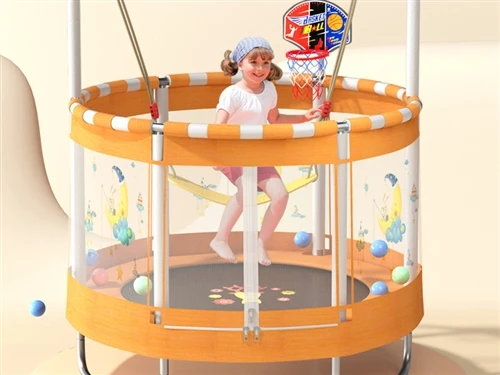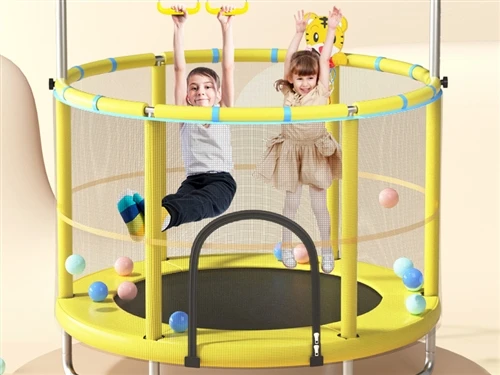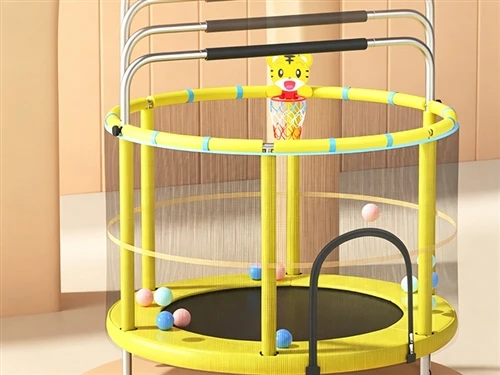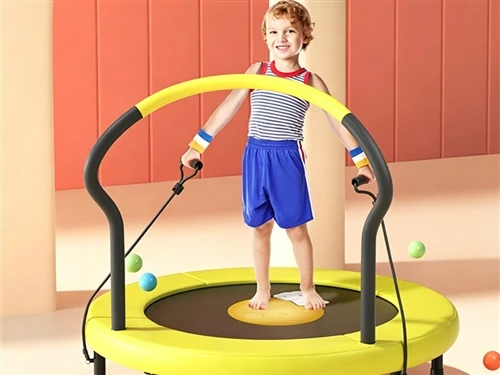
Outdoor trampolines and scenic trampolines are common facilities for children's outdoor recreation. Their design integrates sports science, materials engineering, and safety standards, aiming to provide a fun and safe activity space for children aged 3-12. The core difference between these two types of trampolines lies in their usage scenarios and structural strength: outdoor trampolines are mostly used in everyday places such as residential areas and parks, emphasizing portability and basic protection; scenic trampolines need to adapt to high traffic and complex terrain, requiring higher standards for material durability and installation stability. Both use galvanized steel sheets and plastics as their main materials, employing an underground design to lower the center of gravity and avoid the risk of tipping over. They also utilize a circular structure to disperse impact force and reduce collision injuries to children.
From a material perspective, galvanized steel sheets, as the core material of the trampoline frame, have excellent corrosion resistance and structural strength. Their galvanized surface layer can isolate air and moisture, remaining rust-free for more than 10 years even in humid environments, making them particularly suitable for the variable weather conditions in scenic areas. The plastic components are primarily used for protective edging of the trampoline's edges, made of high-density polyethylene (HDPE), which is UV-resistant and impact-resistant, and will not become brittle even after prolonged exposure to sunlight. This material combination ensures the trampoline's durability while reducing the risk of injury from bumps and knocks through rounded corners.
In terms of safety design, both types of trampolines adhere to the principles of children's biomechanics. The in-ground installation embeds the trampoline body 30-50 cm into the ground, bringing the center of gravity close to the ground and effectively preventing the equipment from tipping over due to children's jumps. The circular structure evenly distributes impact force, avoiding the stress concentration problem at the corners common in square trampolines and reducing the risk of frame deformation. Furthermore, the trampoline surface uses a highly elastic mesh fabric with a tensile strength exceeding 2000N/5cm, providing sufficient bounce while preventing breakage due to material aging. These design details collectively form the safety foundation of children's outdoor trampolines.
The two types of trampolines also have some differences in details to suit different usage scenarios. Outdoor trampolines typically come with removable safety nets, allowing for flexible installation by families or communities as needed. Ground trampolines in scenic areas use fixed safety railings, generally over 1.2 meters high, to prevent children from tipping over while jumping. Both types offer professional on-site installation services, ensuring equipment stability through procedures such as level calibration and anchor bolt fixing. For public places like scenic areas, additional foundation reinforcement is added to address potential ground subsidence.